
What do these papers mean?
Summons and Complaint Regarding Parental Obligations (form FL-600)
- If you received form Fl-600 ️, the Local Child Support Agency (LCSA) has filed papers asking for the court to order that you or the child's other parent pay child support.
- They may also be asking for the court to determine if you and the other person listed in the papers are the child's legal parents.
- If you do not respond, the attached proposed Judgment Regarding Parental Obligations (form FL-680) will become final.
This page will help you understand what the form means and your options for what to do next.
Who is asking for a court order
The Local Child Support Agency (LCSA) filed the case. They are the Petitioner. The LCSA is part of the California Department of Child Support Services.
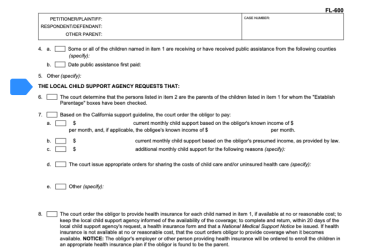
What the LCSA wants the court to decide
On page 3 of the Summons and Complaint, the LCSA lists what they want the court to order.
For example, the LCSA may be asking for an order about
-
Legal parent-child relationship
If item 7 is checked, the LCSA is asking the court to decide if you and the other parent are the child's legal parent (called established parentage).
-
Child support
If item 8 is checked, the LCSA has asked for the court to order the "obligor" to pay child support. This may also include sharing the costs of child care. The obligor is the person listed on Page 2 in item 2(c).
-
Health insurance
If item 9 is checked, the LCSA has asked that the court order the obligor to pay for the child's health insurance, if available at a reasonable cost.
The LCSA also asks for a wage and earnings assignment. This means that child support is taken directly from someone's paycheck.
How to respond and what happens if you don't
You can respond by filing an Answer (form FL-610) ️ in court.
- In your Answer, you can say if you agree or disagree with the amount of child support.
- If you don't agree you are a child's parent, the court can order genetic testing.
If you don't file an Answer within 30 days of getting these papers, the LCSA can ask the court to decide the case without your input.
- This is called a default.
- The proposed Judgment will become the final court order.
In certain situations, instead of an Answer, you may want to file other papers telling the court that you don’t want to participate because the LCSA made a mistake in their case. Some examples include:
- There is already another case open
- The case was filed in the wrong place (for example, the child doesn’t live in the county where the case is filed)
- You weren’t served properly
It is very important that you understand what can happen if you do or do file a response. Talk to your court's family law facilitator or self-help center ️or a lawyer for more information.
If you agree with what the LCSA has asked for, you may choose not to respond and the case will continue without you. The proposed Judgment will likely become the final court order.
If the papers ask the court to establish you as the child's legal parent, the court can do so without a DNA test if you don't respond.
- It is very hard to undo a court order establishing you as a child's legal parent even if you later take a DNA test that shows you are not a biological parent.
If the LCSA did not ask to establish parentage, but you think you're not the parent
- The LCSA will not check "establish parentage" next to a child's name in item 1 on Page 1 if there's already a legal determination you are the child's legal parent.
- This means there's a judgment (final court order) that says you are the child's legal parent, you're married to the other parent, or you signed a Voluntary Declaration of Parentage or Paternity (VDOP).
- If you think that is not correct and you are not the child's legal parent, talk to a lawyer or your court's family law facilitator or self-help center ️ as soon as possible to find out your options.
- If you signed a VDOP, it may be possible to have the VDOP canceled. But, you must act quickly.
- Having a judgment undone (set aside) is very difficult and there are strict deadlines.